FotoArtFestival Diary
Peter Marshall
Bielsko-Biala, June 9-13, 2005
Friday 10June

Almost an exhibition of my work at the Teatr Baniluka, 10/06/2005
15:31:35. There are 9 A1 size prints and 20 around 38x25cm. Eventually this
work was moved to SFERA because of insuperable installation
problems.
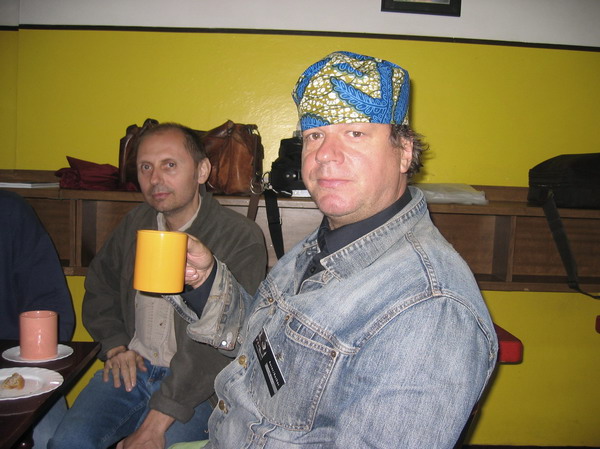
Vasil Stanko and Stefan Bremer in a cafe on Rynek, 10/06/2005 16:24:25
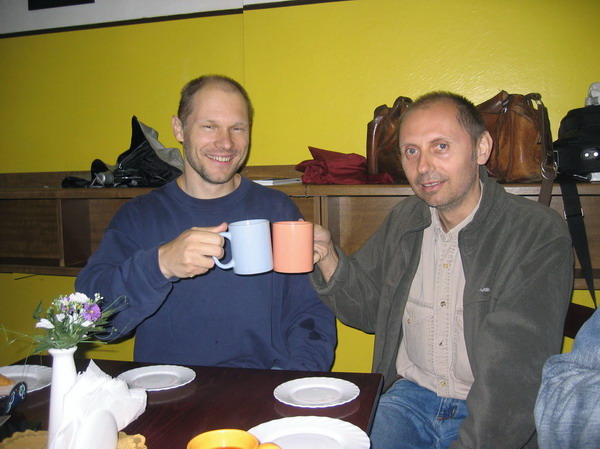
Jan Kruml and Vasil Stanko
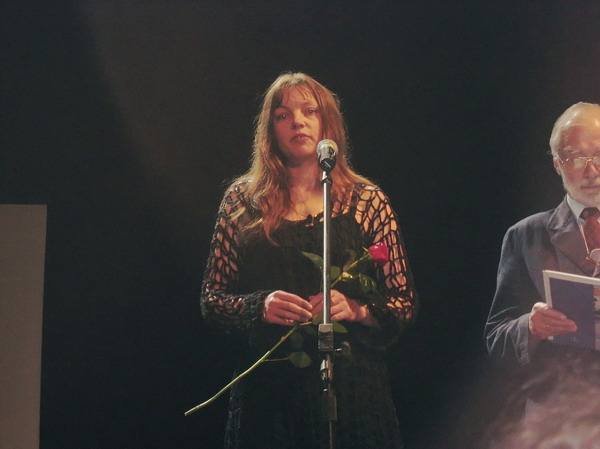
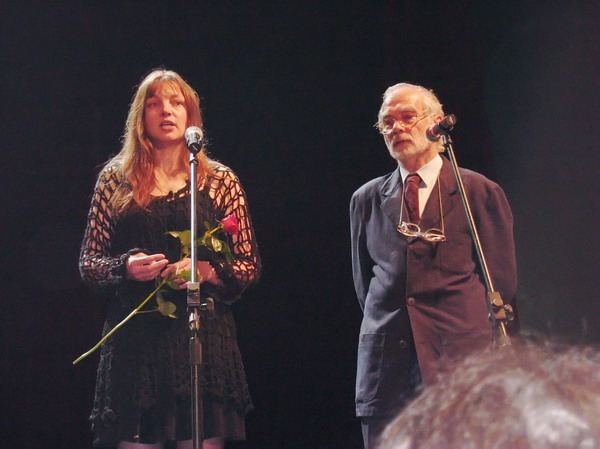
Inez and Andrzej Baturo.at the opening ceremony at the Bielskie Centrum Kulturyj.
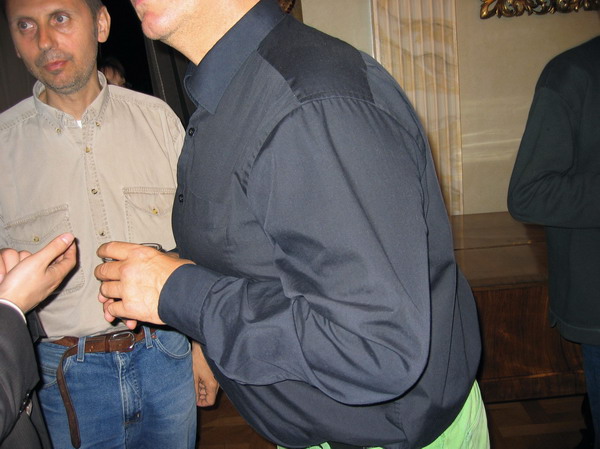 Vasil at the party at the castle
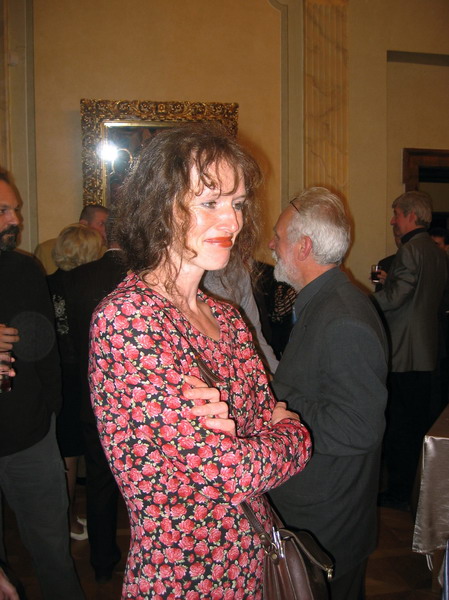
Sarah Saudek
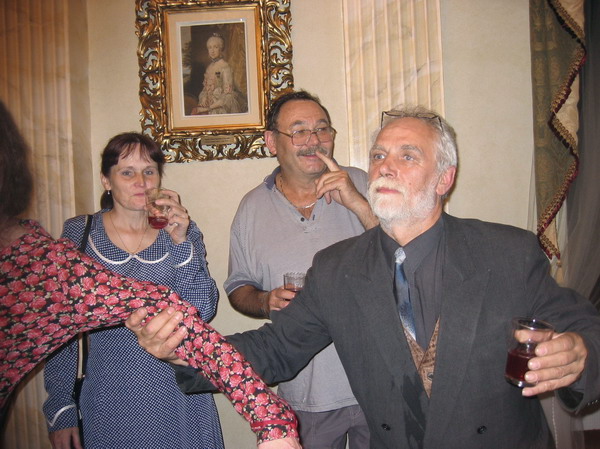
and friends, including a thoughtful Obie.
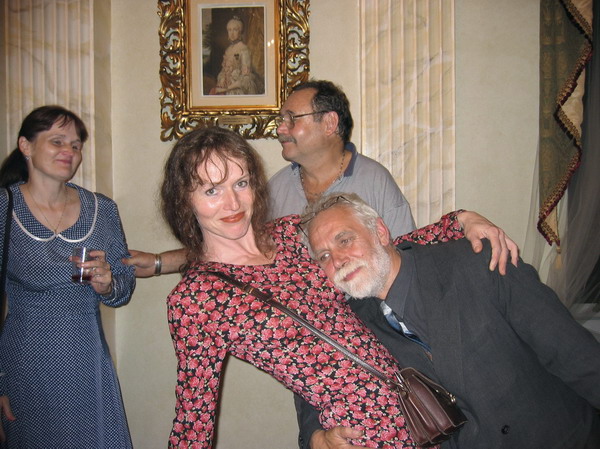
more pictures
Thoughts from Bielsko
Less than 95 theses (continued)
- Its no coincidence that the Szarkowski and Adams are both photographers
as well as writers. I’ve always considered that the people who know
most about our medium are the people who do it. Those who have written most
cogently have all had at least a reasonable proficiency at it and a firm
grounding in its traditions. Of course there are also plenty of good photographers
who have not been able to articulate in any way about the medium, and some
who have talked nonsense. But in so far as photography has attracted serious
criticism rather than critical indifference, there are many to whom my response
is simply that they have not paid their dues.
- Visual language, some say, is universal. More bullshit. No two of us looking
at a picture see the same picture. Yes, there will be some common perceptions
that arise from our shared cultural and sub-cultural soup, but the way that
we interpret the visual is critically dependent on our culture, our history.
For a trivial example, a triangle in England is simply a triangle, while
in Poland it can signify and classify a toilet. Symbols such as the cross
and swastika are also examples of radically different visual language, for
example between Hindu and Christian.
- Bullshit 3 is truth, or at least the idea that photojournalists and documentary
photographers are on a mission to uncover it. Point of view is fundamental
to photography. Literally and metaphorically.
Watching people photograph the proceedings earlier, photographers on the
unfamiliar end of the lens, Bevis commented that digital cameras made it
hard to tell the amateur from the professional, we all use the same equipment
now. But it isn't the camera that matters. Working professionally (whether
as amateur or pro) come down to point of view. Deciding what you want to
say (metaphor) and getting in the right place to do it (literal.) Then of
course there is knowing how to hold the camera - and a little luck.
Some months ago in one of those phone interviews where they work through
a standard list of questions, a journo from and amateur photo mag came to
"what is your favourite photo accessory?" I don't think
my answer, "Ten thousand miles of shoe leather" made
it to print.
Truth is seldom simple. Facts look different depending where you come from.
Photographers lack - and really need to lack - the Divine guidance needed
for certainty. At best we have a personal integrity, an open mind and an
honest vision. And make pictures that reflect the complexities of the real
world.
- Photography is an iceberg. Nine-tenths is underwater, hidden from view.
Occasionally parts of that great mass break away and float to the surface
– as when the work of Mike Disfarmer was published by Julia
Scully and others.
Its instructive to think what a history or overview of photography written
in the 1920s or 1930s might have looked like. We can be fairly sure that
some of those who would have featured most prominently, for example, William
Mortensen, author of Pictorial Lighting, 1932, Projection Control,
1934, Monster & Madonnas: A Book of Methods, 1936, The Command to
Look, 1937, The Model, 1937
and more, are among those now largely relegated to footnotes, while the
photographer many of us would regard as the most important of the early
years of the century, Eugene Atget, would not have got a mention.
There are many photographers who are not particularly well-known whose
work is of interest, and often of rather more interest than some of those
who have made the history books. Fame is about being in the right place
at the right time and knowing the right people.
-
Photography is not an American medium, nor does it belong to Dusseldorf.
Much of the most interesting things that are happening in photography
now take place away from these centres. Despite the efforts of historians
and authors - such as Naomi Rosenblum - we still have a very long way
to go in discovering twentieth century photography outside of the United
States of America. (I wonder how much space Polish photography gets in
her latest ‘World History’, being promoted during this festival.)
I’m ashamed to have written virtually nothing on it to date. However
In my features on my website ‘About Photography’ I try to
show a world view of photography, for example with the series of features
on photography in Central and South America. Along with the work of many
others thesehave helped shine a little light on photography in this vibrant
and active region.
- In a real sense there is no such thing as 'a photographer'. We don't exist
in isolation. Our often fragile and fraught egos (often seen as evidence
of artistic temperament) belie what we all know, that we are a part of a
community. Our ideas, our pictures, build on the shoulders of others. Becoming
a photographer is very much about connecting with this community. My talk
is a very personal one, about some of the people - famous and relatively
unknown - who have been important in my life and my photography.
This event in Bielsko-Biala is a powerful manifestation
of that community, and one that has transcended our different nationalities,
languages and status. The friendship, the fellowship I've felt here has
moved me to the very bowels of my heart. But this is a community which I
think is now under threat in two respects.
- Photography in various respects is becoming more and more a corporate
buisiness rather than an artistic endeavour. Mega-image corporations aim
to monolopolise image supply, cutting supermarket-style deals with photographers
and image buyers, dragging down prices below that needed to sustain an individual
approach.
- In the fine art world, artists become increasing synthetic, predicated
by the demands of the market (for exampe for limited editions in our essentially
replicating medium.)
- I am very much a grass roots person, a believer in participation as the
basis of building better lives and a better society. What really matters
is the ordinary and the vernacular, although when we examine them closely
we find that they are very particular. We can perhaps learn far more about
the real history of photography by looking at those who have not made the
history books.
You can download a zip file of
the 3 talks I wrote for Bielsko-Biala (text only.)
These include an introduction which contains some of the above material,
but was rewritten in Poland, and presentations on the work of two great British
photographers, Tony Ray Jones and Raymond Moore,
another on the work of some of my London Friends, Paul
Baldesare, Jim Barron, Derek Ridgers,
Mike Seaborne and Dave Trainer, and on my
own work.
Peter Marshall
Bielsko-Biala and Staines, June 2005.